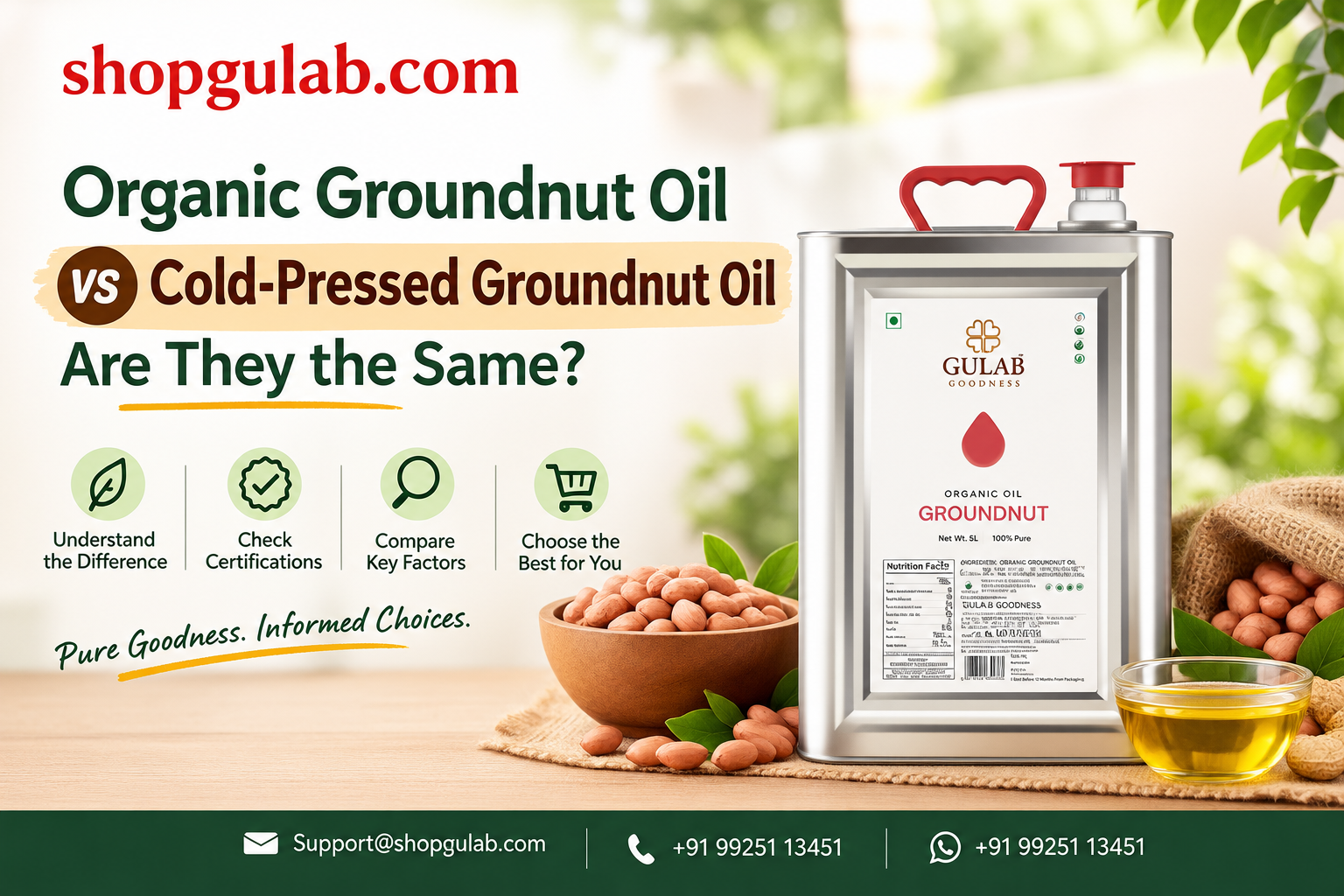
 Walk into an oil aisle or browse an online grocery store, and you may notice two terms appearing frequently: organic groundnut oil ↗ and cold-pressed groundnut oil. Because both sound natural and traditional, it is easy to assume they mean the same thing.
They don't.
The two terms describe different aspects of the oil. “Organic” primarily relates to how the agricultural ingredients are produced and the standards followed for organic certification, while “cold-pressed” describes an oil extraction method.
Understanding this difference can help you make a more informed decision instead of choosing an oil simply because the label sounds healthier.
What Is Organic Groundnut Oil?
Organic groundnut oil is made from groundnuts produced according to applicable organic farming standards. Depending on the certification and production system, organic agriculture focuses on defined practices concerning cultivation, inputs, processing, and handling.
The important point is that organic does not automatically mean cold-pressed.
An oil can be organic while being produced using a particular processing method allowed under the applicable organic standards. Therefore, when shopping, don't assume that the word “organic” tells you everything about the extraction process.
If organic certification is important to you, look for appropriate certification or regulatory information rather than relying solely on words such as “natural,” “pure,” or “chemical-free.”
What Does Cold-Pressed Groundnut Oil Mean?
Cold pressing refers primarily to how oil is extracted from groundnuts.
Groundnuts are mechanically pressed to release their oil, with the process designed around relatively low-temperature extraction rather than conventional high-temperature refining.
This can influence characteristics such as:
-
Natural aroma
-
Characteristic groundnut flavour
-
Colour
-
Processing profile
-
Overall sensory experience
However, cold-pressed does not automatically mean organic.
Groundnuts used for cold pressing may or may not be organically certified. That's why these two terms shouldn't be treated as interchangeable.
The Simple Difference
Think of it this way:
Organic = How the agricultural product is produced and certified
Cold-pressed = How the oil is extracted
This distinction is one of the most important things to understand when comparing cooking oils.
Can Groundnut Oil Be Both Organic and Cold-Pressed?
Yes.
A product can potentially be both organic and cold-pressed when the raw material, processing, handling, and certification requirements are appropriately met.
For example, a product may be made from organically produced groundnuts and extracted through mechanical cold pressing.
In such a case, the two descriptions complement each other rather than competing with each other.
But don't assume that every product carrying one term automatically qualifies for the other. Always check the product label and manufacturer's information.
Organic Groundnut Oil vs Cold-Pressed Groundnut Oil: A Quick Comparison
The easiest way to understand the difference is to look at what each term actually describes.
1. Main Meaning
Organic Groundnut Oil:
Refers to groundnut oil made from groundnuts produced according to applicable organic production standards and requirements.
Cold-Pressed Groundnut Oil:
Refers mainly to the method used to extract oil from groundnuts through mechanical pressing.
2. What Does It Focus On?
Organic Groundnut Oil:
The focus is mainly on how the groundnuts are grown, sourced, processed, and certified where applicable.
Cold-Pressed Groundnut Oil:
The focus is on the oil extraction process rather than whether the groundnuts were organically produced.
3. Does Organic Mean Cold-Pressed?
Not necessarily. An organic groundnut oil product does not automatically have to be cold-pressed. Always check the product label and processing information.
4. Does Cold-Pressed Mean Organic?
No. Cold-pressed describes the extraction method. Groundnuts used for cold-pressed oil are not automatically organic.
5. Can Oil Be Both Organic and Cold-Pressed?
Yes. A product can be both organic and cold-pressed when its raw materials, processing, handling, and applicable certification requirements support both claims.
6. What Should Buyers Check?
When buying organic groundnut oil, check:
-
Organic certification or relevant certification information
-
Ingredient details
-
Extraction method
-
Manufacturing and best-before dates
-
Packaging quality
-
Manufacturer or seller information
In Simple Words
Organic = How the groundnuts are produced and certified.
Cold-Pressed = How the oil is extracted.
How Is This Different from Refined Groundnut Oil?
The biggest difference is often the processing approach.
Refined groundnut oil generally goes through additional refining processes intended to remove or reduce certain impurities, odours, colours, and other components. Cold-pressed oil, by contrast, is associated with mechanical extraction and generally undergoes a less intensive processing route.
This can result in noticeable differences in flavour, aroma, appearance, and cooking experience.
Neither the word “refined” nor “cold-pressed” should be treated as a complete quality verdict on its own. The right choice depends on what you value in an everyday cooking oil.
Why Does Organic Groundnut Oil Price Vary?
If you have searched for organic groundnut oil price, you may have noticed considerable differences between products.
That's normal because the final price can be influenced by several factors, including:
-
Cost and availability of organically produced groundnuts
-
Certification and compliance requirements
-
Processing method
-
Filtration
-
Packaging
-
Batch size
-
Storage and transportation
-
Seller and distribution costs
Therefore, comparing only the price of two bottles may not give you a meaningful comparison.
Instead, compare the source, certification, processing method, packaging, quantity, and product information alongside the price.
A higher price does not automatically mean better quality, and a lower price does not automatically mean poor quality.
How to Identify the Best Organic Groundnut Oil
Searching for the best organic groundnut oil can quickly become confusing because every brand may describe its product differently.
Instead of relying on advertising language, use a simple checklist.
1. Check the Organic Claim
If the product is marketed as certified organic, look for relevant certification information.
2. Check the Ingredient Information
The product should clearly state what type of oil you are purchasing.
3. Understand the Extraction Method
If you specifically want cold-pressed oil, make sure the product description actually states the extraction method.
4. Check Packaging
Look for a properly sealed container with clear labelling and suitable storage instructions.
5. Check Dates
Review manufacturing/packing information and the best-before details where provided.
6. Consider the Seller
A transparent seller should provide sufficient product information rather than relying entirely on promotional claims.
For packaged foods in India, FSSAI's Labelling and Display Regulations cover requirements for pre-packaged foods and essential information. Checking the official regulations can help consumers understand why reading the label matters.
FSSAI – Labelling & Display Regulations ↗
What About Buying Organic Groundnut Oil Online?
Searching for organic groundnut oil online gives you access to more products than you might find at a local shop. But having more choices also means you need to compare products carefully.
Before ordering, check:
-
Product description
-
Organic certification information
-
Extraction method
-
Net quantity
-
Manufacturer/marketer details
-
Packaging
-
Manufacturing or packing information
-
Best-before information
-
Customer reviews
-
Seller information
Don't make your decision solely because a product has a large discount or hundreds of reviews.
A detailed product description is usually more useful than a flashy advertisement.
Does Organic Mean Healthier?
This is where consumers should be particularly careful.
Organic certification describes production standards, not a guarantee that a particular food will provide extraordinary health benefits.
Similarly, cold pressing describes an extraction method, not a promise that the oil will prevent or cure a disease.
A responsible buying decision should focus on verified product information rather than exaggerated health claims.
This is also why E-E-A-T matters when writing or reading food-related content: trustworthy information should distinguish between what a product label means, what the production process involves, and what has actually been established scientifically.
Which One Should You Choose?
There isn't one universal answer.
If your priority is organically produced agricultural ingredients, you may specifically look for a properly certified organic groundnut oil.
If your priority is a mechanically extracted oil with a traditional groundnut aroma and flavour, you may prefer cold-pressed groundnut oil.
And if you want both characteristics, look for a product that clearly identifies itself as organic and cold-pressed, with appropriate supporting information.
The key is not to confuse the two terms.
Final Thoughts
So, are organic groundnut oil and cold-pressed groundnut oil the same?
No.
They describe different things. Organic refers primarily to the production and certification standards associated with the agricultural ingredients, while cold-pressed refers to the extraction method.
The two can exist together, but one does not automatically guarantee the other.
Before buying, read the label, understand the processing method, verify relevant certification claims, compare the product details, and don't judge quality based on price alone.
If you're comparing different cooking oils or need help selecting a suitable pack, Contact Us ↗ for product information and assistance.
For consumers looking for organic and traditionally processed cooking oils, Shop Gulab ↗ provides another option to consider when comparing products and specifications.