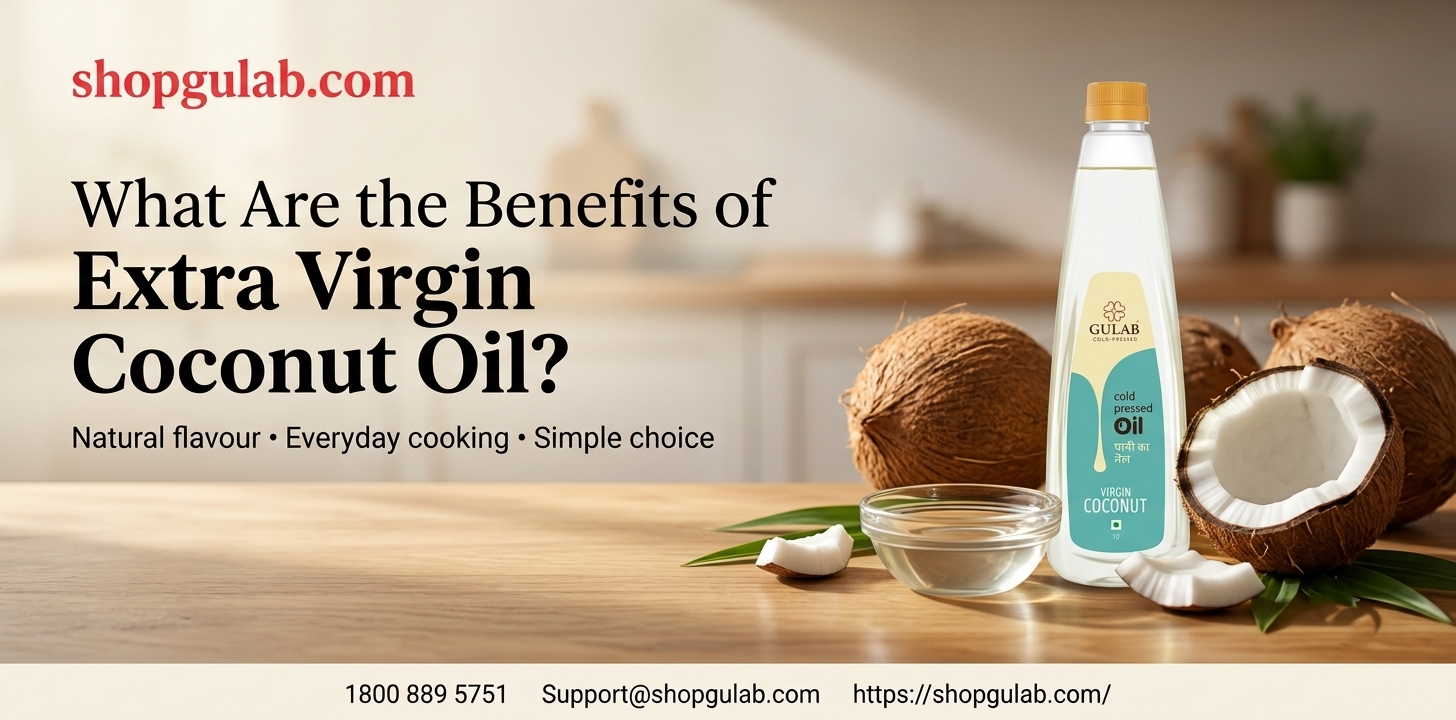
 There are some ingredients that don't need an introduction in an Indian kitchen. Coconut is one of them.
Depending on where you live, coconut may show up in chutney, curry, sweets, snacks, or a simple vegetable dish. Coconut oil has been used alongside these foods for years, and now there is growing interest in extra virgin coconut oil ↗ in particular.
But what actually makes it different? And does it deserve all the health attention it gets?
The simple answer is that extra virgin coconut oil can be a useful cooking oil, especially when you like its natural flavour and use it sensibly. It has a particular fatty-acid profile and works beautifully in certain recipes. At the same time, it is high in saturated fat, so calling it a “superfood” and using it without limits would be misleading.
So, What Is Extra Virgin Coconut Oil?
The name can make the product sound complicated, but the basic idea is quite simple.
Extra virgin coconut oil is generally made from fresh coconut rather than dried coconut meat. Compared with heavily refined coconut oil, it usually keeps more of the characteristic coconut smell and taste.
That difference is easy to notice when you cook with it.
A good extra virgin coconut oil doesn't need a strong artificial flavour to remind you that it came from coconut. The aroma itself does the job.
When buying one, though, don't stop at the words “extra virgin” on the front of the bottle. Check the ingredients, packaging, processing information, and storage instructions as well.
Why Do People Choose It?
For many people, the first reason is not even health. It is taste.
Try it with a South Indian-style vegetable preparation or a simple coconut-based curry, and you'll understand why coconut oil has stayed popular for so long. It gives the dish a mild, recognizable character that a completely neutral cooking oil simply doesn't provide.
That makes extra virgin coconut oil particularly useful when you want the cooking oil to contribute something to the final dish.
It Has a Different Fat Profile
Coconut oil is quite different from oils such as sunflower, soybean, or groundnut oil.
It contains a high amount of saturated fat, including lauric acid. Coconut oil is also often discussed because some of its fatty acids are classified as medium-chain fatty acids.
This is where online discussions can become confusing. You will find claims saying coconut oil can boost metabolism, support weight loss, or solve various health problems. The evidence does not justify treating it as a cure-all.
What we can say more confidently is that coconut oil has a distinctive nutritional profile, and that profile is one reason researchers continue to study it.
For everyday eating, the bigger picture matters: how much oil you use, what other fats you eat and what the rest of your diet looks like.
Is Extra Virgin Coconut Oil Good for Cooking?
It can be.
Extra virgin coconut oil for cooking is a practical option for recipes where its flavour suits the dish. It can be used for sautéing, certain baking recipes, and traditional preparations where coconut oil is already part of the food culture.
The important point is not to assume that “cold-pressed” or “extra virgin” means you should use unlimited amounts.
The American Heart Association recommends choosing unsaturated plant oils more often than tropical oils that are high in saturated fat, particularly when heart health is a concern. American Heart Association – Healthy Cooking Oils ↗
So, if coconut oil is a regular part of your cooking, think about what role it plays in your overall diet rather than judging it in isolation.
It Works Especially Well in Traditional Cooking
This is something nutrition discussions sometimes overlook.
Food isn't only about nutrients. Flavour matters too.
Coconut oil has a natural place in many regional Indian dishes. When used in the right recipe, it adds aroma and richness without needing a long list of additional ingredients.
A small amount in a tempering can change the whole smell of a dish. The same is true for certain chutneys, vegetable preparations, and coconut-based recipes.
That is a perfectly good reason to keep it in the kitchen.
What About the Antioxidants?
Virgin coconut oil contains naturally occurring compounds, and antioxidant activity is one of the areas that has been studied in relation to less-refined coconut oils.
That sounds impressive, but it is worth keeping the claim in perspective.
Having antioxidant compounds in an oil does not mean that eating more of that oil will automatically protect you from disease. Good nutrition rarely works that way.
Instead, think of these compounds as one part of the oil's natural composition—not as a reason to treat coconut oil like a medicine.
Can You Eat Extra Virgin Coconut Oil?
Yes, it is an edible cooking oil, so using extra virgin coconut oil for eating is perfectly possible.
But there is no special advantage in taking spoonfuls of it on an empty stomach simply because someone online says it is healthy.
It makes much more sense to use it as part of actual food.
Add it to a recipe where you like the flavour. Use it in homemade baking. Cook a traditional dish with it. In other words, let it be food rather than turning it into a supplement.
How Do You Choose the Best Extra Virgin Coconut Oil in India?
Searching for the best extra virgin coconut oil in India can leave you with dozens of similar-looking bottles.
Instead of getting distracted by big claims on the label, look for a few straightforward things.
Start with the ingredient list. The product should clearly tell you what you're buying.
Then check the packaging and storage instructions. Oils are sensitive to heat, light, and air, so proper storage matters.
Freshness is another practical consideration. When you open the bottle, the oil should have a pleasant coconut aroma. A stale or unpleasant smell is not something to ignore.
And finally, consider how you'll use it. Paying a premium for an oil that doesn't suit your cooking habits isn't necessarily good value.
What About Extra Virgin Coconut Oil Price?
The extra virgin coconut oil price can vary quite a bit from one product to another.
The reason isn't always simply “better quality.” Coconut sourcing, extraction methods, packaging, bottle size, and brand positioning can all influence the price.
A smarter comparison is to calculate the cost per 100 ml or per litre.
Also remember that a larger bottle is not automatically a better deal if you use coconut oil only occasionally. Buy according to your actual kitchen routine.
Is It Healthier Than Every Other Cooking Oil?
No single oil deserves that title.
Extra virgin coconut oil has some qualities that make it appealing: a distinctive flavour, a different fatty-acid composition and a long history of use in traditional cooking.
But it is also high in saturated fat.
That means it makes more sense to use it thoughtfully than to replace every cooking oil in your kitchen simply because it is labelled “extra virgin.”
A varied diet and sensible portions will take you much further than chasing the idea of a perfect oil.
The Practical Takeaway
The biggest benefit of extra virgin coconut oil may simply be that it is easy to use and enjoyable in the right food.
It can bring real coconut flavour to everyday cooking, works well in several traditional recipes, and can be part of a balanced diet when used in reasonable amounts.
The health story is worth understanding, but it doesn't need to be exaggerated.
If you like coconut oil, choose a good-quality product, store it properly, and use it where its flavour makes sense. That's a far more realistic approach than treating one bottle of oil as the answer to every nutrition question.
Contact Us ↗: For more information about coconut oil and available products, contact Shop Gulab ↗.